
Introduction
There is a local saying that Mumbai is a city, but Bombay is an emotion. As we move into 2026, Mumbai deserves a prime place on every traveller's itinerary, not just for its storied past, but for its thrilling, rapidly evolving present. India's financial and entertainment capital is a place of staggering contrasts: soaring glass skyscrapers stand shoulder-to-shoulder with Asia's largest slums; billionaire tycoons share the pavement with resilient street vendors; and serene centuries-old temples are engulfed by the relentless hum of modern traffic. For the budget backpacker and the internationally minded explorer, Mumbai offers a masterclass in human resilience, diversity, and chaotic beauty.
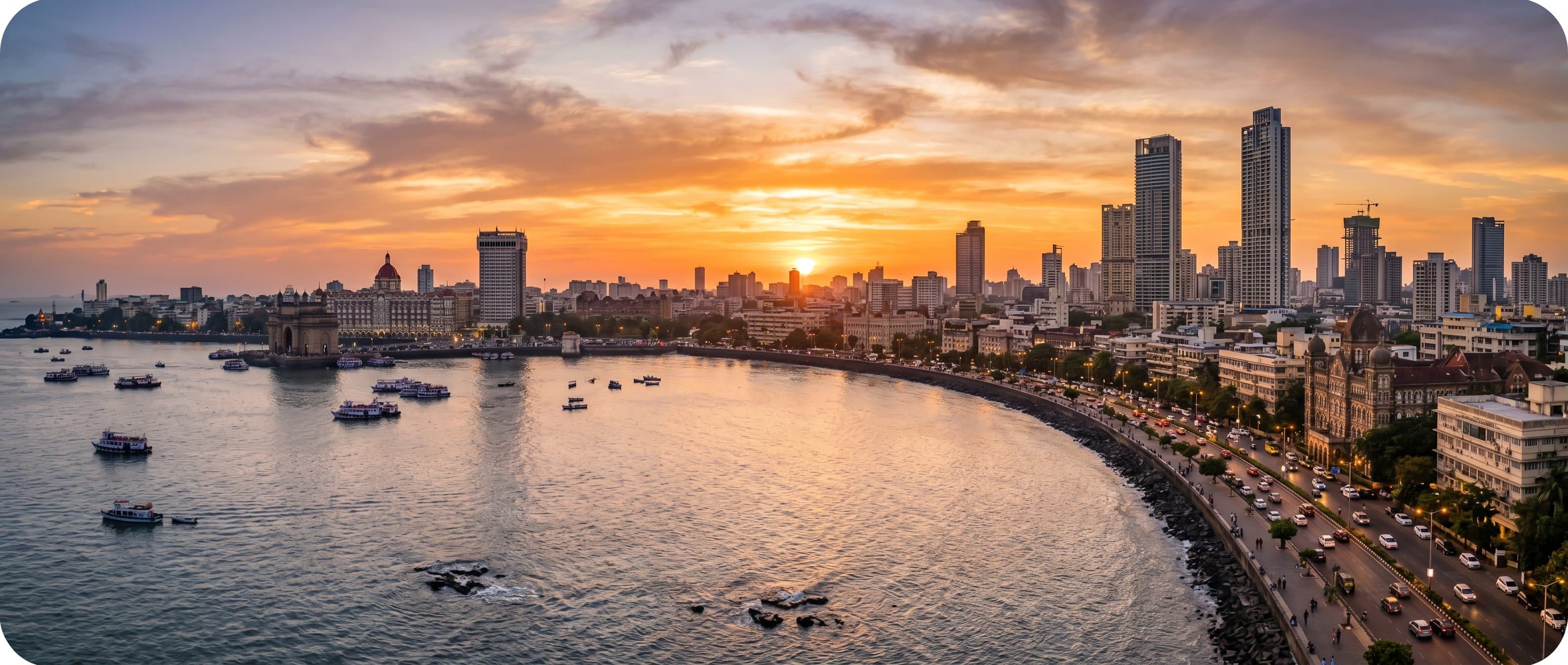
Why visit Mumbai right now? 2026 marks a transformative era for the city. The long-awaited Coastal Road and the expansive Aqua Line (Metro Line 3) have finally rewired the city's notorious traffic, connecting the historic, leafy avenues of South Mumbai to the bustling, hip suburbs of Bandra and Andheri faster than ever before. Yet, despite this modernisation, Mumbai's soul remains untouched. You come here for the unmatched, electrifying street food culture, the thriving indie arts scene in Kala Ghoda, and the sheer cinematic romance of watching the sun dip below the Arabian Sea along the Queen's Necklace. It is a city that demands your energy but repays you with unforgettable, visceral experiences.
Best Time to Visit
Mumbai's climate is famously uncompromising, heavily dictated by the Arabian Sea and the dramatic Indian monsoon. The absolute best time to visit is during the post-monsoon and winter months, from November to February. During this 'sweet spot', the humidity drops to manageable levels, the skies are a piercing blue, and daytime temperatures hover around a pleasant 25°C to 30°C. This is also the peak season for outdoor festivals, walking tours, and open-air rooftop bars.
March through May brings the sweltering Indian summer. Temperatures soar above 35°C, but the crippling 80-90% humidity is what truly tests a traveller's endurance. If you visit during this time, air-conditioning becomes your best friend, though you will be rewarded with the glorious Alphonso mango season. From June to September, the heavens open for the legendary Mumbai monsoon. While there is a profound, poetic romance to watching the rain batter the Gateway of India while sipping hot Irani chai, the practical reality for backpackers is grim: flooded streets, cancelled local trains, and rampant travel delays. October acts as a transition month, famously known as the 'October Heat', where the rains retreat but temperatures temporarily spike before winter sets in.
Travel Planning & Booking
For international backpackers, Chhatrapati Shivaji Maharaj International Airport (BOM) is your gateway. Major carriers like British Airways, Virgin Atlantic, Air India, and Emirates (via Dubai) operate daily, seamless routes. Direct flights from London Heathrow take roughly 9 hours, while those coming from New York (JFK) can expect a 15-hour direct haul on Air India or United. To secure the best fares, especially during the peak winter months, book your flights at least 3 to 4 months in advance using platforms like Skyscanner for route comparisons, and Google Flights for price tracking. For internal Indian travel, the MakeMyTrip app is indispensable for booking domestic flights, trains, and buses.
Visa requirements for India are strict but increasingly digitised. As of 2025/2026, passport holders from the UK, US, EU, and UAE are eligible for the Indian e-Visa (e-Tourist Visa), which must be applied for online at least 4 days prior to arrival. You can opt for a 30-day, 1-year, or 5-year multiple-entry visa. Ensure your passport has at least six months of validity and two blank pages. Print your ETA (Electronic Travel Authorization) before boarding, as immigration officials in Mumbai will require a physical copy along with your return flight ticket and proof of accommodation for the first night.
Travel Insurance
Travel insurance is not an optional extra when visiting Mumbai; it is an absolute necessity. The city's frenetic pace, dense crowds, and distinct culinary landscape mean that minor mishaps can quickly escalate. You must ensure your policy covers medical emergencies, specifically for waterborne or foodborne illnesses (like gastroenteritis, colloquially known as 'Delhi Belly'), which frequently catch newly arrived travellers off guard. Furthermore, if you are travelling near the monsoon season, trip cancellation and disruption cover is vital, as flooded train tracks and delayed flights are common occurrences.
We highly recommend three providers for the 2026 travel landscape: World Nomads, which is unmatched for adventurous backpackers looking for robust, flexible cover that can be extended on the road; SafetyWing, perfect for digital nomads offering a highly affordable, subscription-based model; and Allianz Travel Insurance, which provides premium, comprehensive packages with excellent medical evacuation cover. Practical Tip: Keep a digital copy of your insurance certificate and emergency assistance number saved offline on your phone, as mobile data coverage can occasionally drop inside Mumbai's thick concrete heritage buildings or deep within the local train network.
Packing Guide
Packing for Mumbai requires a strategic approach focused on climate control and cultural respect. The coastal humidity means breathable, lightweight fabrics are mandatory—pack linen shirts, loose cotton trousers, and moisture-wicking t-shirts. Despite the heat, Indian culture leans towards modesty. When visiting religious sites like the Haji Ali Dargah or Siddhivinayak Temple, both men and women must cover their shoulders and knees. Women should carry a lightweight scarf or dupatta; it takes up zero space but is incredibly versatile for temple visits or shielding yourself from the sun.
Mumbai-specific must-brings include a high-capacity power bank (navigating via Google Maps drains batteries quickly), a universal travel adapter (India uses Type C, D, and M plugs), medical-grade activated charcoal or rehydration sachets for stomach upsets, and sturdy, slip-on sandals. You will be taking your shoes off constantly for temples and people's homes. The biggest tourist mistake? Over-packing heavy denim jeans and bulky hiking boots. Denim takes days to dry in the Mumbai humidity and will leave you uncomfortably hot, while heavy boots are entirely impractical for the city's paved but uneven streets.
Accommodation
Choosing the right neighbourhood in Mumbai defines your entire experience, as the city is incredibly elongated and traffic can be punishing. Colaba and Fort (South Mumbai) are the historic, atmospheric heartlands, packed with Victorian architecture, museums, and tourist landmarks. Bandra West, the 'Queen of the Suburbs', is Mumbai's hipster and expat enclave, known for its street art, indie cafes, Bollywood celebrity homes, and vibrant nightlife. Andheri (Juhu/Versova) is ideal if you want to be closer to the airport, the beach, and the modern entertainment industry.
For a spectacular luxury splurge, the Taj Mahal Palace in Colaba is an iconic heritage property overlooking the Gateway of India; it is a monument in its own right, offering unparalleled grandeur. For a mid-range boutique experience, Abode Bombay (also in Colaba) is a sensational choice—an eco-friendly, impeccably designed boutique hotel that blends vintage Bombay charm with modern chic. Budget backpackers should look no further than Zostel Mumbai in Marol (near the airport) for a highly social, clean, and safe hostel environment with excellent access to the Metro. Booking tip: Accommodation in Mumbai is significantly more expensive than the rest of India. Book at least two months in advance for the winter season, and always check if local taxes (GST, up to 18%) are included in the quoted price.
Getting Around Locally
Arriving at Chhatrapati Shivaji Maharaj International Airport (CSMIA), the safest and most efficient way to the city centre is via the pre-paid taxi counters inside the arrivals hall, or by booking an Uber/Ola using the airport's free Wi-Fi (head to the designated ride-hailing pickup zones). A ride to South Mumbai takes about 60 to 90 minutes depending on traffic and costs roughly 800-1200 INR ($10-$15).
Navigating Mumbai locally is an adventure. The Mumbai Local Train network is the city's vital artery, carrying millions daily. It is incredibly cheap (less than $0.50 per ride) and fast, bypassing all road traffic. The Western Line (Churchgate to Borivali) and Central Line (CSMT to Kalyan) are the most useful for tourists. Auto-rickshaws (tuk-tuks) are cheap and strictly run on the metre, but legally they are not permitted to travel into South Mumbai (past Bandra/Sion). In South Mumbai, you will use the iconic black-and-yellow (Kaali-Peeli) taxis or Uber. BEST Buses cover the entire city and are useful for short hops. One common tourist mistake: Attempting to board a Mumbai Local train during peak rush hours (8:00 AM–10:30 AM and 5:30 PM–8:30 PM). The crush of humanity is notoriously intense and genuinely unsafe for those carrying luggage or unfamiliar with the boarding etiquette.
Top Tourist Attractions (Must-See)
1. Gateway of India: Built to commemorate the 1911 royal visit of King George V, this basalt arch is Mumbai's most iconic landmark. It matters because it is the literal and figurative entry point to the city's colonial past. Open 24/7, free entry. Best time: 6:30 AM to watch the sunrise and avoid the aggressive touts. Insider tip: Skip the expensive hotel breakfasts and grab a bun-maska and chai at a nearby street stall while watching the boats bob in the harbour.
2. Chhatrapati Shivaji Maharaj Terminus (CSMT): A UNESCO World Heritage site, this operational railway station is a breathtaking masterpiece of Victorian Gothic Revival architecture blended with Indian traditional motifs. Open 24/7, free (unless taking a heritage tour). Best time: Early evening when the facade is spectacularly illuminated. Insider tip: View it from the dedicated viewing gallery opposite the Brihanmumbai Municipal Corporation (BMC) building for the perfect photograph.
3. Elephanta Caves: Located on an island a 60-minute ferry ride from the Gateway of India, these 5th-century rock-cut temples are dedicated to Lord Shiva. Hours: 9:00 AM - 5:30 PM (Closed Mondays). Entry: 600 INR for foreigners. Best time: Take the first ferry at 9:00 AM. Insider tip: Beware of the aggressive monkeys on the island; do not carry visible food or shiny objects.
4. Dhobi Ghat: The world's largest outdoor laundry, where thousands of 'dhobis' (washermen) hand-wash the city's linens in concrete pens. It represents Mumbai's incredible, hidden systemic efficiency. Free to view from the Mahalaxmi Station bridge. Best time: 8:00 AM when the washing is at its most frantic. Insider tip: View it from the bridge; descending into the ghats often results in locals demanding impromptu 'tour guide' fees.
5. Marine Drive (The Queen's Necklace): A 3.6-kilometre sweeping, C-shaped boulevard along the coast. It is the democratic heart of Mumbai where billionaires and beggars sit side-by-side facing the sea. Open 24/7, free. Best time: Sunset (6:00 PM). Insider tip: Start at Nariman Point and walk north towards Chowpatty beach to watch the city lights turn on, forming the glowing 'necklace'.
6. Sanjay Gandhi National Park & Kanheri Caves: A massive protected forest within the city limits, home to wild leopards and the ancient Kanheri Buddhist caves (dating from the 1st century BCE). Park entry is 85 INR, plus 300 INR for the caves. Hours: 7:30 AM - 5:30 PM (Closed Mondays). Insider tip: Rent a bicycle at the park entrance; it is the most serene, enjoyable way to reach the caves through the dense forest.
7. Colaba Causeway: Mumbai's premier street shopping drag. It matters because it's a sensory overload of textiles, antique brass, jewellery, and energetic bargaining. Hours: 10:00 AM - 9:30 PM. Insider tip: Never accept the first price; polite but firm haggling is expected. Start by offering 40% of the initial asking price.
8. Haji Ali Dargah: A stunning 15th-century Indo-Islamic shrine located on an islet off the coast of Worli, accessible only by a narrow causeway during low tide. Hours: 5:30 AM - 10:00 PM. Free entry. Insider tip: Check the local tide charts before visiting; the pathway is completely submerged during high tide, making access impossible.
Local Food & Dining
Mumbai's culinary scene is a spectacular reflection of its diverse migrant history. You cannot leave without trying the Vada Pav, the city's ultimate on-the-go snack: a deep-fried spiced potato dumpling squashed inside a soft bread bun (pav), smothered in fiery garlic and coriander chutneys. Pav Bhaji is another icon—a thick, buttery vegetable mash served with toasted rolls. To taste the legacy of Mumbai's Parsi community, try Berry Pulao, and for coastal flavours, seek out Bombay Duck (which is actually a fiercely pungent, deep-fried fish, not a bird!).
For a spectacular high-end dining experience, book a table at The Bombay Canteen in Lower Parel. It brilliantly reinvents regional Indian dishes with modern flair in a stunning colonial-bungalow setting. For a historic mid-range meal, head to Britannia & Co. in Ballard Estate, a legendary heritage Parsi cafe (open only for lunch) where the faded grandeur and berry pulao transport you to the 1920s. For the ultimate street food experience, visit the stalls at Girgaon Chowpatty at sunset for fresh Bhel Puri and Pav Bhaji. Dietary Note: Mumbai is exceptionally accommodating to vegetarians and vegans, with vast menus dedicated entirely to plant-based diets, but those with severe nut or dairy allergies must exercise caution and communicate clearly, as ghee (clarified butter) and cashews are ubiquitous.
Safety & Emergency Contacts
Mumbai is generally considered one of the safest metropolises in India, especially for solo female travellers, with a vibrant nightlife and people out on the streets until the early hours. However, violent crime is rare but petty theft is not. Exercise standard urban caution: guard your belongings in crowded markets like Crawford Market and on the local trains. Be prepared for staring, which is usually out of curiosity rather than malice, and be cautious of sophisticated scams near tourist spots (e.g., someone 'accidentally' squirting dirt on your shoes and demanding money to clean them). Avoid venturing deep into unfamiliar slums without a reputable, community-led NGO guide (like Reality Tours & Travel).
The healthcare system in Mumbai boasts some of the finest private hospitals in Asia. The nearest premier facility for international tourists is Breach Candy Hospital in South Mumbai. Save these verified emergency numbers: Police: 100; Ambulance: 108; Fire: 101; National Emergency: 112; Tourist Police (Mumbai HQ): +91 22 2262 0111. The British Deputy High Commission is located at Naman Chambers in BKC (+91 22 6650 2222); the US Consulate General is also in BKC (+91 22 2672 4000); and foreign nationals requiring visa assistance can contact the FRRO office in Fort (+91 22 2262 0446).
Useful Apps & Resources
Your smartphone is your ultimate survival tool in Mumbai. m-Indicator is the single most important app you will download; it provides flawlessly accurate, real-time schedules for local trains, buses, and ferries. Uber and Ola are essential for safe, hassle-free taxi and auto-rickshaw rides without the need to haggle over meters. Zomato and Swiggy dominate food delivery and restaurant reviews, invaluable for those lazy hostel nights. BookMyShow is the go-to app for booking cinema tickets, stand-up comedy, and cultural events. Finally, for official advisories, the Maharashtra Tourism Development Corporation website (www.maharashtratourism.gov.in) provides reliable regional information.
Closing
Mumbai is a city that never stops moving, and it demands that you keep pace. It will exhaust you, exhilarate you, and profoundly change the way you view the world. From the quiet majesty of its gothic arches to the chaotic symphony of its traffic, every corner offers a new story. Pack light, keep an open mind, and embrace the magnificent chaos. Ready to plan your next great adventure? Explore more expertly curated, budget-friendly guides and travel hacks at ainexusworld.com to turn your travel dreams into reality.