
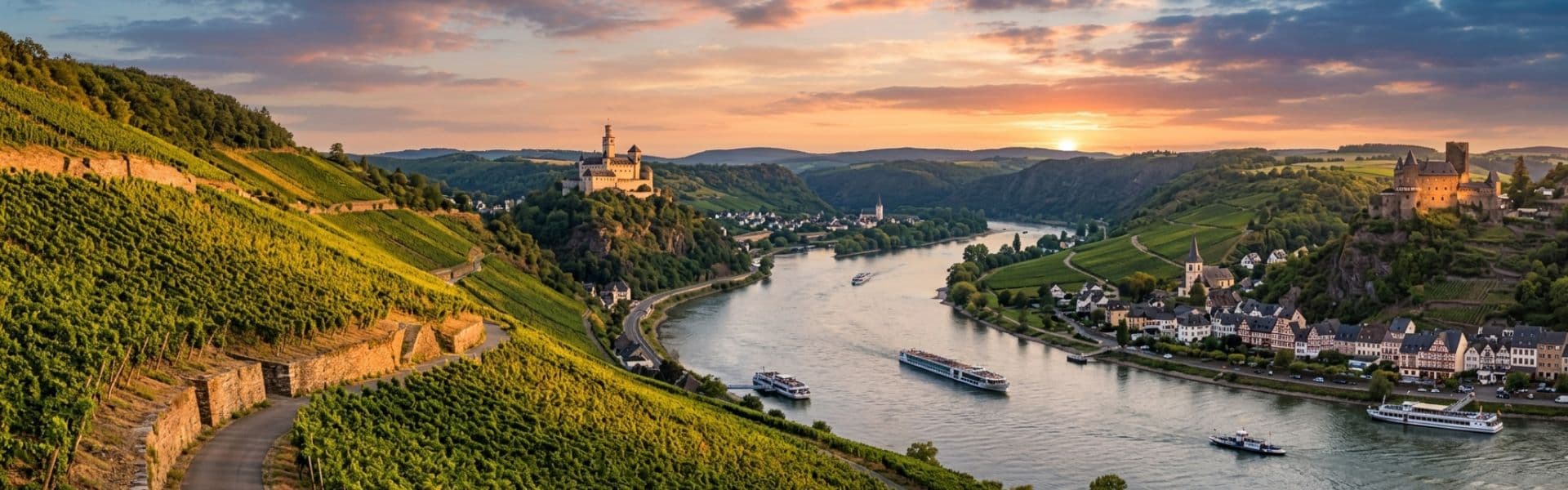
The Rhine Valley is the 65-kilometre stretch of the Rhine River between Koblenz and Bingen/Rüdesheim am Rhein, known officially as the Upper Middle Rhine Valley and inscribed as a UNESCO World Heritage Site in 2002. Along this narrow gorge, more than 40 castles and fortress ruins sit on hilltops above steep Riesling vineyards, and half-timbered wine towns line both riverbanks. Most visitors explore it as a day trip or short break from Frankfurt, Cologne or Mainz, combining a train ride with a river cruise, a castle visit and a wine tasting.
This guide covers what the Rhine Valley is actually like to visit, the towns and castles worth prioritising, how to get there without a car, how long to stay, and where the common planning mistakes happen.
Why Visit the Rhine Valley
The Rhine Valley earned its UNESCO listing for the way the landscape, castles, vineyards and towns document centuries of human settlement along a difficult stretch of river. Practically, that means a compact area where you can cover a lot of ground: a castle interior in the morning, a riverside lunch, a vineyard walk in the afternoon and a wine tasting in the evening, all within a corridor a few kilometres wide.
The gorge is also unusually easy to see without a car. Trains run along both banks, small ferries cross the river at several points, and Köln-Düsseldorfer (KD) river cruises connect the main towns, so a car-free itinerary using train and boat is realistic for most travellers.
Best Things to Do in the Rhine Valley
Take a Rhine River Cruise
A cruise is the best way to see the castles in sequence rather than one at a time. KD is the main operator, running scheduled boats along the Loreley Valley section between Rüdesheim/Bingen and St. Goar/St. Goarshausen, with longer routes extending to Koblenz. Smaller regional operators run shorter circular cruises from individual towns. Full-length cruises take several hours in each direction, so many travellers cruise one way and take the train back to save time.
Visit the Castles You Can Actually Enter
Not every castle on the Rhine is open to the public — some are privately owned, some are ruins you can walk through freely, and a few operate as hotels. The two most visited are:
- Marksburg Castle, above Braubach — the only Rhine castle never destroyed or rebuilt, giving the most complete look at a medieval fortress. Access is by guided tour.
- Burg Rheinfels, in St. Goar — once the largest fortress on the Rhine, now an extensive ruin with underground mine tunnels and self-guided grounds access.
Also worth seeing: Pfalzgrafenstein, the striking toll castle on an island in the river near Kaub (reached by a small ferry from Kaub itself), and Burg Reichenstein above Trechtingshausen, which now houses a furnishings and armour collection. Burg Katz near St. Goarshausen is privately owned and can only be admired from outside or from the surrounding trails.
Hike the Rheinsteig
The Rheinsteig is a long-distance trail running along the eastern bank of the gorge, connecting many of the castle viewpoints and vineyard paths. You don't need to walk the full route — short sections between towns like Rüdesheim, St. Goarshausen or Boppard give you elevated views over the river without committing to a multi-day hike.
Taste Riesling in the Vineyards
The steep slopes of the gorge are planted almost entirely with Riesling, along with some Spätburgunder (Pinot Noir) and Müller-Thurgau. Rüdesheim's Drosselgasse is the most touristy place to try a glass, but vineyard estates around Bacharach, Boppard and Assmannshausen offer tastings with more direct access to the growers.
See the Loreley Rock
Near St. Goarshausen, the Loreley is a 132-metre slate cliff tied to the legend of a siren whose song lured sailors onto the rocks below. There's a viewpoint accessible from the plateau above, and it's one of the narrowest, most dramatic points of the river for photos, whether you're on a cruise or driving/cycling the riverside road.
Best Towns to Base Yourself In
| Town | Best For | Notes |
|---|---|---|
| Rüdesheim am Rhein | First-time visitors, cable car views | Busiest town, main cruise departure point, Drosselgasse wine bars, cable car to the Niederwald Monument |
| Bacharach | Atmosphere, walkable old town | Medieval walls and towers, Stahleck Castle above town, quieter than Rüdesheim |
| St. Goar | Castle access, central location | Rheinfels Castle in town; good base for reaching Marksburg and other sites by train/ferry |
| Boppard | Longer stays, hiking access | Wide riverside promenade, good Rheinsteig access, less crowded |
| Oberwesel | Small-town charm | Well-preserved medieval walls, close to Pfalzgrafenstein views |
| Koblenz | City base, transport hub | Deutsches Eck (Rhine-Moselle confluence), Ehrenbreitstein Fortress, good rail connections |
St. Goar is often the most practical base logistically, since it sits roughly in the middle of the gorge with train, ferry and cruise connections in both directions. Rüdesheim suits travellers who want the most facilities and the shortest transfer from Frankfurt.
Best Time to Visit the Rhine Valley
| Season | What to Expect |
|---|---|
| Spring (April–May) | Fewer crowds, vineyards turning green, good hiking weather, some smaller attractions may have reduced hours early in the season |
| Summer (June–August) | Peak season — full cruise schedules, warm weather, wine festivals, but the busiest and most expensive months |
| Autumn (September–October) | Grape harvest, wine festivals, autumn colour on the vineyard slopes, still good cruise availability |
| Winter (November–March) | Many castles and some cruise routes close or run reduced schedules; Christmas markets in towns like Koblenz and Rüdesheim are the main draw |
Late spring through mid-autumn (May to early October) is the most reliable window for visiting: castles and cruises run full schedules, and the vineyards look their best either freshly green or turning gold at harvest. If you're travelling outside this window, check individual castle and cruise operator schedules before you go, since winter hours vary and change year to year.
How to Get to the Rhine Valley
The Rhine Valley doesn't have its own airport — most visitors arrive via Frankfurt.
- From Frankfurt (city or airport): Direct regional and long-distance trains reach Rüdesheim, Bingen and Koblenz in well under an hour to just over an hour, depending on the connection. This is the most common gateway route.
- From Cologne: Trains run south along the Rhine to Koblenz and on to the gorge towns, making Cologne a workable alternative base for a day trip.
- From Mainz: A short train ride reaches Bingen, from where a passenger ferry crosses to Rüdesheim.
- Within the valley: Local trains run along both banks of the river, small car-and-passenger ferries cross at several towns (including Bingen–Rüdesheim and St. Goar–St. Goarshausen), and KD river cruises link the towns seasonally. A common approach is to cruise in one direction and take the train back.
A car gives more flexibility for reaching outlying vineyards and viewpoints, but isn't necessary for a first visit — the combination of train, ferry and cruise covers the main towns and castles without one.
How Many Days Do You Need
A single day trip from Frankfurt lets you see one or two towns, one castle, and a short cruise leg — enough for a first taste of the gorge but a rushed one. Two to three days, based in one town with day trips to the others, is a more comfortable pace and allows time for a castle visit, a cruise, a vineyard walk and at least one relaxed evening rather than constant transit.
Where to Stay
Accommodation in the Rhine Valley ranges from simple guesthouses to a handful of hotels operating inside former castles, including converted properties at Rheinfels in St. Goar and Reichenstein in Trechtingshausen. Riverside hotels in Rüdesheim, Bacharach and Boppard tend to book up furthest in advance during the summer and harvest months, so reserve early if travelling June through October.
Food and Wine
Riesling dominates the wine list throughout the valley, with Spätburgunder and Müller-Thurgau as the main alternatives. On the food side, look for Flammkuchen (a thin, crisp flatbread similar to pizza, usually topped with crème fraîche, onion and bacon), Handkäse mit Musik (a marinated soft cheese dish, a Hessen speciality near Rüdesheim), and Sauerbraten with Riesling-based sauces. Wine taverns (Weinstuben) in the smaller towns, rather than the busiest tourist streets, are usually a better source of both food and local wine recommendations.
Suggested 3-Day Rhine Valley Itinerary
- Day 1 — Rüdesheim: Arrive by train from Frankfurt, take the cable car over the vineyards to the Niederwald Monument, walk down through the vines, and spend the evening in Drosselgasse.
- Day 2 — Bacharach and St. Goar: Train to Bacharach for the old town walls and Stahleck Castle viewpoint, then continue to St. Goar to explore Burg Rheinfels.
- Day 3 — Cruise to Braubach and Koblenz: Take a river cruise or train toward Braubach for a Marksburg Castle tour, then continue to Koblenz to see the Deutsches Eck and, if time allows, the Ehrenbreitstein Fortress.
Travel Tips and Common Mistakes
- Don't try to see every castle. Most are visible only from a distance or from the river; pick two or three to actually enter rather than rushing between towns.
- Check cruise schedules before committing to a route. Not all sections run daily or year-round, and schedules are reduced outside the main season.
- Book castle-hotel stays well ahead. The novelty of sleeping inside a Rhine castle means these rooms sell out early in summer.
- Confirm which bank a train station is on. Some towns share a name across both riverbanks, and a ferry — not a bridge — is often how you cross.
- Pack for hills. Castle approaches and vineyard paths are steep; flat shoes matter more than in most German cities.
Is the Rhine Valley Good for Families, Couples or Solo Travellers?
The Rhine Valley suits most travel styles. Families generally do well with the cable car rides, ferry crossings and castle exploring, though some castle interiors involve stairs and uneven surfaces that aren't stroller-friendly. Couples are well served by the wine taverns and scenic viewpoints, particularly outside peak summer crowds. Solo travellers will find the train-and-ferry network easy to navigate independently, and small-town bases like Bacharach or Oberwesel are walkable and low-hassle.
Frequently Asked Questions
What is the Rhine Valley known for?
It's known for the concentration of medieval castles above a narrow river gorge, its Riesling vineyards, and its UNESCO World Heritage status, granted in 2002 for the landscape's long history of human settlement.
How many days are enough for the Rhine Valley?
A single day trip from Frankfurt covers the basics, but two to three days based in one town gives a more relaxed pace and time for a castle tour, a cruise and a vineyard visit.
Do you need a car to visit the Rhine Valley?
No. Trains run along both banks, ferries cross the river at several towns, and seasonal river cruises connect the main stops, so the valley is straightforward to visit using public transport.
Which Rhine castles can you actually go inside?
Marksburg (Braubach) and Burg Rheinfels (St. Goar) are the two main castles open for interior or ruin exploration. Pfalzgrafenstein near Kaub is reachable by a small ferry. Others, like Burg Katz, are privately owned and viewable only from outside.
What is the best base town in the Rhine Valley?
Rüdesheim am Rhein is the most convenient for first-time visitors coming from Frankfurt. St. Goar is a more central option for reaching castles and towns in both directions by train or ferry.
What food should I try in the Rhine Valley?
Riesling wine is the regional signature, alongside dishes like Flammkuchen and, closer to Rüdesheim, Handkäse mit Musik.
Is the Rhine Valley expensive to visit?
Costs vary with season and how much of the trip is cruise-based versus train-based. Summer accommodation in the most popular towns (Rüdesheim, Bacharach) tends to be pricier and books out earlier than in spring or early autumn.