
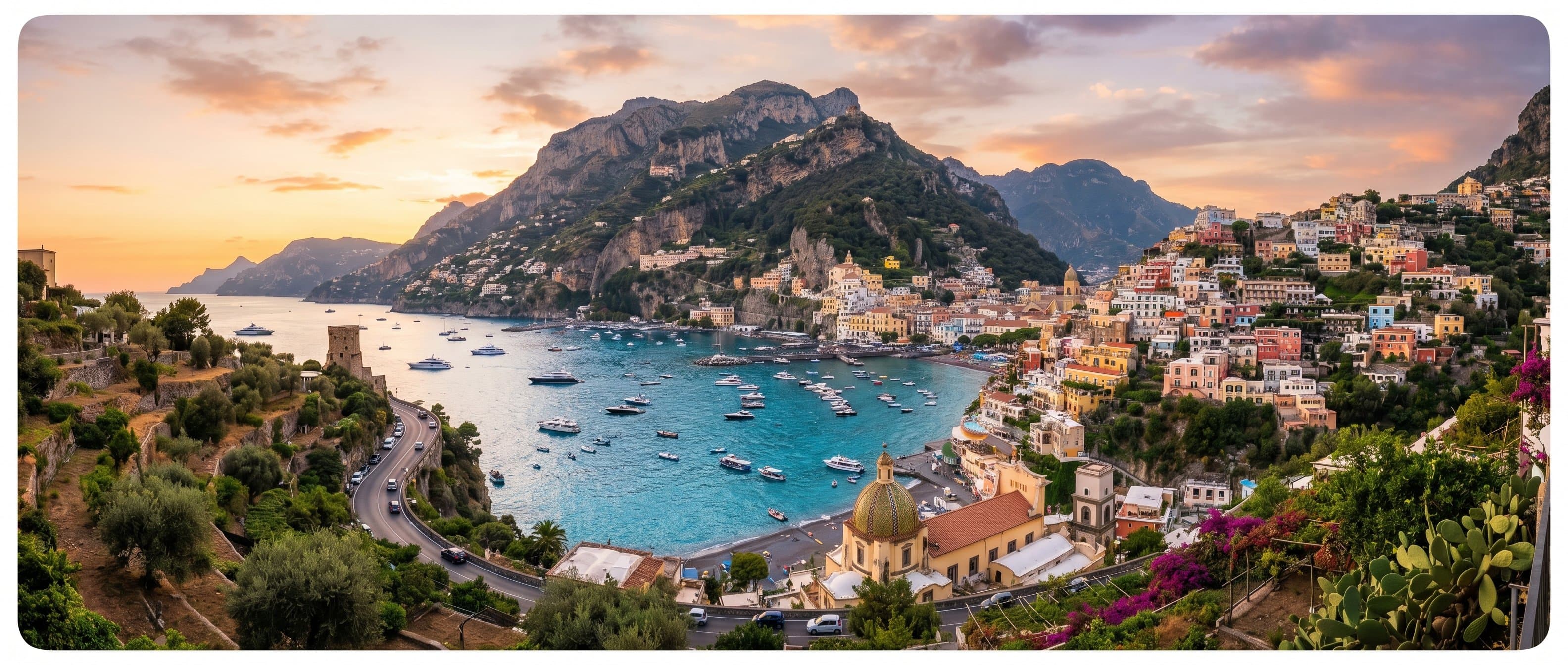
The Ultimate Amalfi Coast Travel Guide 2026: Everything You Need to Know
Suspended between the azure Mediterranean Sea and the rugged peaks of the Lattari Mountains, the Amalfi Coast (Costiera Amalfitana) is arguably Italy's most mesmerising stretch of shoreline. For decades, it has been the playground of Hollywood elite and luxury seekers. However, beneath the veneer of five-star cliffside resorts lies an untamed, spectacular landscape perfectly suited for the intrepid backpacker. Why does the Amalfi Coast deserve a place on your traveller's list for 2026? Because the recent expansion of the Salerno Costa d'Amalfi Airport (QSR) has completely revolutionised access to the region. Bypassing the notorious bottlenecks of Naples, savvy travellers can now access the southern, more affordable, and authentically local towns like Vietri sul Mare and Cetara with unprecedented ease. Whether you are navigating the vertigo-inducing Path of the Gods or savouring paper-cone fried seafood in a bustling piazza, the Amalfi Coast in 2026 is more accessible—and exhilarating—than ever.
Best Time to Visit
Timing is everything on the Amalfi Coast. The steep geography means that crowds concentrate heavily in narrow thoroughfares, and temperatures dictate both your transport and activity options.
- January to March: The coast is in hibernation. Temperatures hover between 5°C and 15°C. While accommodation is delightfully cheap, up to 70% of hotels, restaurants, and ferry services are closed. It is a peaceful time for pure photography, but logistically challenging.
- April to May: This is the beginning of the awakening. Easter brings the first wave of Italian tourists. May is the absolute sweet spot for backpackers: the weather is warm enough for hiking in a t-shirt (18-25°C), the ferocious summer crowds have not yet descended, and vibrant blooms blanket the cliff faces.
- June to August: Peak season. The heat is intense (up to 32°C+), and the narrow streets of Positano and Amalfi become gridlocked. Budget backpackers will find hostel prices surging and SITA buses filled to capacity. If you must visit in August, base yourself in the higher-altitude village of Agerola to escape the heat and premium prices. Key event: The Feast of Sant'Andrea in Amalfi (June 27), featuring a dramatic procession down the cathedral steps.
- September to October: Another excellent window. The Tyrrhenian Sea retains its summer warmth, making swimming delightful until late October. Early September still feels busy, but by October, the pace slows, and the grape and lemon harvests bring a festive, agrarian charm to the terraced hillsides.
- November to December: Heavy rains often sweep in during November, occasionally causing landslides that disrupt bus routes. December brings a quiet charm with local Christmas markets and nativity scenes (presepi), though many tourist infrastructures remain shuttered.
Travel Planning & Booking
Getting to the Amalfi Coast requires strategic planning. Your primary international gateway remains Naples International Airport (NAP), though the Salerno Costa d'Amalfi Airport (QSR) now handles an increasing number of European budget flights (like easyJet and Ryanair). If flying from the US, UK, or India, you will likely route through Rome (FCO) or Milan (MXP) before catching a high-speed Frecciarossa train to Naples Centrale or Salerno.
For budget backpackers, booking lead time is critical. Secure your hostel or guesthouse at least four to five months in advance for May-September travel. The Amalfi Coast has extremely limited budget accommodation, and the few excellent spots (like Ostello Brikette) sell out rapidly.
Booking Platforms: Use Hostelworld for finding the rare dorm beds in Positano and Sorrento; Booking.com for securing family-run agriturismi (farm stays) up in the hills; and Ferryhopper to book your boat transfers in advance, which is essential during July and August.
2026 Visa Requirements: The long-awaited ETIAS (European Travel Information and Authorisation System) is now fully operational. UK, US, and UAE citizens travelling visa-free to the Schengen Area must apply online for an ETIAS authorisation (fee applies, valid for 3 years) at least 96 hours before departure. Indian nationals must still apply for a traditional Schengen Visa through VFS Global well in advance. Always carry your passport, proof of onward travel, and a physical copy of your travel insurance.
Travel Insurance
Do not even consider travelling to the Amalfi Coast without robust travel insurance. This is not a standard city break. The topography presents unique challenges: the famed Path of the Gods (Sentiero degli Dei) features sheer drops and uneven terrain where ankle sprains are common. Furthermore, many tourists rent scooters (Vespas) to navigate the winding SS163 highway—a notoriously dangerous road with blind corners, aggressive local bus drivers, and sheer cliff drops. Medical cover that explicitly includes emergency helicopter evacuation is vital, as ambulances cannot easily navigate the congested coastal roads. Look for policies from World Nomads (excellent for hiking and scooter cover), SafetyWing (great for longer-term nomads), or Allianz. Practical Tip: Ensure your policy explicitly covers you for riding a two-wheeled vehicle over 50cc if you plan to rent a Vespa, and check that you hold an International Driving Permit (IDP).
Packing Guide
The cardinal rule of the Amalfi Coast: Do not bring a heavy, hard-shell suitcase. You will encounter hundreds of steep, uneven stone steps to reach your accommodation, and there are no escalators. A sturdy, 40-50L travel backpack is non-negotiable.
For a summer visit, pack breathable linen shirts, quick-dry activewear for hiking, and a lightweight waterproof jacket (coastal winds can be unpredictable). Culturally, Italians dress impeccably, even casually. When entering churches, including the Duomo di Amalfi, shoulders and knees must be covered—a lightweight scarf is perfect for this. For footwear, pack proper trail-running or hiking shoes; tourists attempting the Path of the Gods in flimsy sandals are routinely turned back by local authorities. The item tourists over-pack? High heels. The cobblestones and relentless staircases make them entirely useless and dangerous here.
Accommodation
Where you base yourself dictates your entire Amalfi experience. Positano is the glamorous, gravity-defying poster child of the coast, but it is phenomenally expensive and crowded. Amalfi Town serves as the primary transport hub, making it excellent for exploring, though it lacks evening tranquility. For the budget backpacker, Praiano or the mountain village of Agerola (Bomerano) are the true gems, offering authentic local life, vastly cheaper beds, and direct access to hiking trails.
- Luxury: Il San Pietro di Positano. A staggering architectural marvel carved into the cliffside with a private beach elevator and Michelin-starred dining.
- Mid-Range: Hotel Margherita (Praiano). Offers breathtaking sunset views, a beautiful lemon-grove terrace, and exceptional local hospitality without the Positano price tag.
- Budget/Boutique: Ostello Brikette (Positano). One of the very few traditional backpacker hostels on the coast, featuring a legendary terrace where you can sip cheap wine while overlooking the million-dollar view. Booking Tip: Always check if your accommodation is located 'on the main road' or 'up the steps'. If it's the latter, prepare for a daily cardiac workout.
Getting Around Locally
Navigating the Amalfi Coast is an adventure in itself. From Naples Airport (NAP), the cheapest route is the Alibus to Napoli Centrale station (€5), followed by the Circumvesuviana train to Sorrento (€4), and finally a SITA bus down the coast. Alternatively, direct shuttle buses like Curreri Viaggi run from NAP to Sorrento for about €10.
Locally, your lifeline is the SITA Sud bus network. Tickets cost between €1.50 and €5.50 and must be bought in advance at a tabaccheria (tobacconist) or bar; you cannot buy them on board. In summer, buses are notoriously overcrowded, and it is common to watch two or three full buses pass you by. Therefore, ferries (Travelmar) are the superior, albeit slightly more expensive, alternative. Travelling by sea offers unmatched views and entirely avoids the gridlocked coastal road. One common tourist mistake: Renting a car to 'explore at your own pace'. The SS163 is terrifying for unaccustomed drivers, parking can cost up to €10 per hour, and a minor scratch on a rental car will decimate your backpacker budget.
Top Tourist Attractions (Must-See)
Beyond the beaches, the coast is steeped in medieval history and natural wonders.
- Path of the Gods (Sentiero degli Dei): A spectacular 7km cliffside hike from Bomerano to Nocelle. It offers the most breathtaking, vertigo-inducing views in Italy. Free entry. Open 24/7. Best done at 7:00 AM to avoid the midday sun. Insider tip: Start in Bomerano; this routes you slightly downhill with Positano constantly in your forward view.
- Duomo di Amalfi (Amalfi Cathedral): A striking 9th-century cathedral blending Arab-Norman and Gothic architecture. Entry €3 (for the cloister and crypt). Hours: 9:00 AM - 6:45 PM. Insider tip: The absolute best photos of the golden facade are taken from the bottom of the grand staircase just as the sun sets.
- Villa Cimbrone Gardens (Ravello): High above the coast, these manicured English gardens end in the 'Terrace of Infinity', lined with marble busts against a backdrop of endless blue. Entry €10. Hours: 9:00 AM - Sunset. Insider tip: Arrive right at opening time to have the romantic terrace entirely to yourself.
- Villa Rufolo (Ravello): The inspiration for Richard Wagner's Parsifal, featuring cascading Moorish gardens. Entry €8. Hours: 9:00 AM - 6:00 PM. Insider tip: Check the local schedule; during summer, a stage is built over the cliff for world-class orchestral concerts.
- Emerald Grotto (Grotta dello Smeraldo): A marine cave bathed in surreal green light due to an underwater fissure. Entry €7. Hours: 9:30 AM - 4:00 PM. Insider tip: The water colour is most vibrant between 12:00 PM and 1:30 PM when the sun is directly overhead.
- Fiordo di Furore: A dramatic, hidden cove where the sea cuts into a deep gorge, spanned by an arched bridge. Free entry. Insider tip: Do not attempt to park here; take the SITA bus and ask the driver to stop at 'Il Fiordo'. Arrive early as the tiny beach fills up by 10 AM.
Local Food & Dining
Campania is the culinary heart of southern Italy. The Amalfi Coast specialises in simple, incredibly fresh ingredients: lemons, tomatoes, and seafood. You absolutely must try Scialatielli all'Amalfitana (thick, short pasta with mixed local seafood), Colatura di Alici (an ancient Roman-style anchovy syrup from Cetara), and a classic Delizia al Limone (a sponge dome soaked in limoncello and covered in lemon cream).
- High-End: La Sponda (Positano). Located in Le Sirenuse, this Michelin-starred venue is illuminated by 400 candles every evening. Essential for a once-in-a-lifetime splurge.
- Mid-Range: Trattoria da Gemma (Amalfi). Operating since 1872, it offers incredible tuna carpaccio and traditional local flavours on a beautiful terrace overlooking the main street.
- Street Food: Cuoppo d'Amalfi (Amalfi). Grab a paper cone overflowing with lightly battered, deep-fried calamari, prawns, and catch-of-the-day for under €10. Perfect for budget backpackers eating on the go.
Dietary Note: Italy is surprisingly excellent for gluten-free (senza glutine) diets, with many pharmacies and restaurants stocking high-quality GF pasta. However, strict vegans may struggle slightly beyond simple tomato pastas and salads, as seafood and dairy heavily dominate the local cuisine.
Safety & Emergency Contacts
The Amalfi Coast is extremely safe regarding violent crime; the primary hazards are environmental and vehicular. The steep stairs are slippery when wet, and the roads are dangerous for pedestrians. Petty theft (pickpocketing) is common on the crowded SITA buses and the Circumvesuviana train from Naples. Always keep your daypack on your front when on public transport. In case of an emergency, the nearest major medical facility with an emergency room is the Ospedale Costa d'Amalfi located in Castiglione di Ravello.
Useful Apps & Resources
Your smartphone is your best travel tool here. Download Trenitalia for booking high-speed trains to Naples/Salerno. Use Ferryhopper to check live schedules and book boat transfers. The Unico Campania app is essential for buying digital tickets for local buses and trains in the region. TheFork is great for securing restaurant reservations and occasionally finding discounts, while Google Translate (with offline Italian downloaded) will help when deciphering local menus in smaller villages. Finally, always consult the official local tourism board website at www.amalficoast.com for live updates on trail closures.
FAQ
Is the Amalfi Coast suitable for budget backpackers?
Yes, but it requires strategy. Avoid staying in Positano or Amalfi Town. Base yourself in Agerola, Salerno, or Praiano, utilise the SITA buses instead of taxis, and eat street food like the famous 'cuoppo' or pizzas from local bakeries.
Can I drink the tap water on the Amalfi Coast?
Absolutely. The tap water is safe, cold, and delicious. You will also find public drinking fountains (fontanelle) in most town squares where you can refill your water bottle for free.
Do I need an International Driving Permit to rent a scooter?
Yes. By Italian law, non-EU residents must present an International Driving Permit alongside their native driver's license. Rental agencies will refuse you without it, and police fines are steep.
How difficult is the Path of the Gods?
It is moderately difficult. While the elevation gain isn't massive if you start from Bomerano, the path is rocky, uneven, and features sheer drops without guardrails. It is entirely unsuitable for those with severe vertigo or mobility issues.
Are credit cards widely accepted?
Visa and Mastercard are accepted at all hotels and most restaurants. However, you must carry cash (€1 and €2 coins are gold dust) for small purchases like bus tickets, public toilets, espresso at local bars, and tips.
Closing
The Amalfi Coast is a destination that demands a little sweat, a lot of stair-climbing, and a spirit of adventure. By stepping off the luxury trail and embracing the local rhythm—taking the ferry instead of a private driver, hiking ancient mule tracks, and eating in family-run trattorias—you will discover the authentic soul of southern Italy. Start planning your 2026 Italian adventure today, and for more insider guides, hidden gems, and budget hacking tips for Europe, continue exploring www.ainexusworld.com.