Badami Cave Temples Travel Guide: History, Timings & Best Places to Visit

If you're looking for a place that genuinely stops you in your tracks, the Badami Cave Temples belong on your list. Carved into rust-red sandstone cliffs sometime in the 6th and 7th centuries, these 4 cave temples sit above a quiet lake in northern Karnataka and pack more history per square metre than most places in India. This Badami Cave Temples travel guide covers everything: the caves themselves, how to get here, what it costs, and how to plan a trip that's actually worth the journey.
Badami doesn't get the crowds that Hampi does. That's partly what makes it special. You can actually stand in front of a 1,400-year-old Nataraja carving and take your time with it.
Planning a heritage trip in Karnataka? Don’t miss our detailed Hampi Travel Guide covering the best places to visit, itinerary ideas, sunset points, cafes, photography spots, budget travel tips, and everything you need to plan an unforgettable trip to the ancient ruins of Hampi.
Where is Badami located?
Badami in Karnataka
Badami is a small town in the Bagalkot district of northern Karnataka. It sits about 500 km from Bangalore, roughly 160 km from Hubli, and about 140 km from Hampi. The nearest large city is Hubli, which has both a major railway station and an airport.
Getting here takes some planning, but the distances aren't brutal if you come from Hubli or Hospet.
Distances at a glance
- Bangalore to Badami: approximately 500 km (overnight train or 8–9 hour drive)
- Hubli to Badami: approximately 160 km (3–3.5 hours by road)
- Hampi to Badami: approximately 140 km (3 hours by road)
- Hospet to Badami: approximately 130 km (2.5 hours by road)
History of Badami Cave Temples
The Chalukya dynasty and rock-cut architecture
Badami was the capital of the Early Chalukya dynasty, which ruled this region from the 6th to 8th centuries CE. The Chalukyas built their kingdom here and left behind a remarkable body of rock-cut and structural architecture that influenced temple design across South India for centuries after.
The cave temples were largely created during the reign of King Kirtivarman I and his successor Mangalesha in the late 6th century. Cave 3 carries an inscription dated 578 CE, making it one of the earliest datable rock-cut temples in Karnataka.
Religious significance
Three of the 4 caves are Hindu (dedicated to Shiva and Vishnu) and one is Jain. This mix reflects the religious tolerance of the Chalukya rulers, who patronised multiple traditions without conflict. The carvings inside each cave show a deep familiarity with the Puranic texts and a sculptural skill that's hard to overstate.
Badami was also called Vatapi in ancient texts. The town appears in the Mahabharata as a place of significance, though the cave temples themselves are a Chalukya creation.
Why visit Badami Cave Temples?
The carvings are the whole point
The stone sculpture here is exceptional. The Nataraja panel in Cave 1 shows Shiva with 18 arms, each in a different mudra, all carved with precision that still impresses archaeologists. Cave 3 has a massive Vishnu in anantashayana pose (reclining on the cosmic serpent) that fills an entire wall. These aren't faded remnants; much of the carving is still sharp.
The setting itself
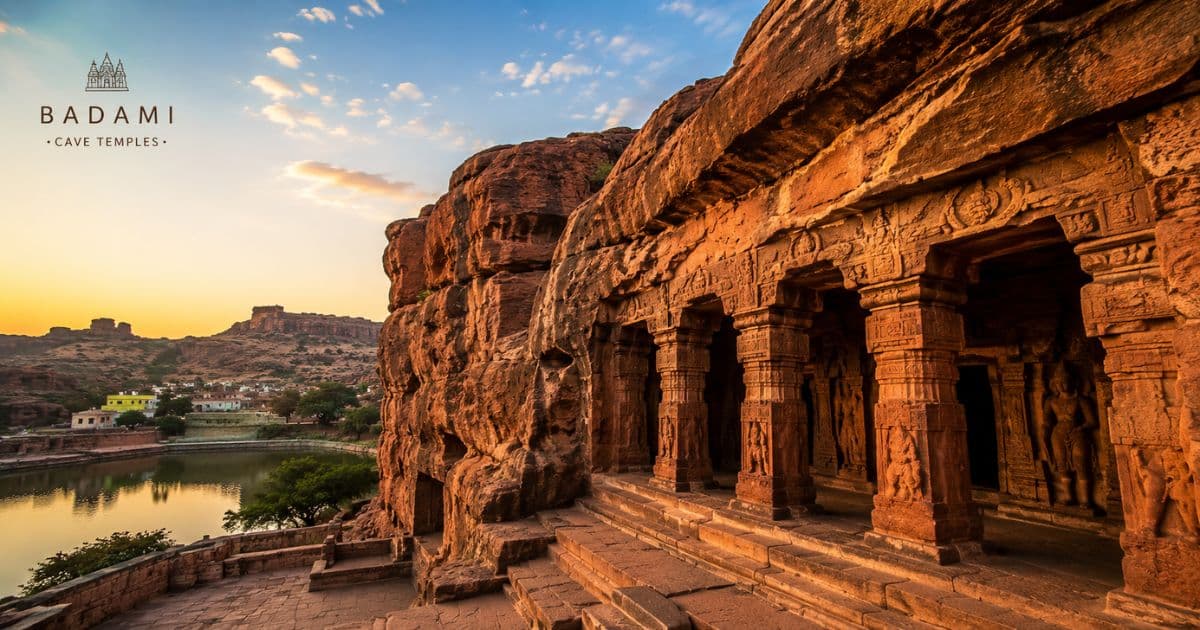
The caves sit in a horseshoe-shaped sandstone escarpment above Agastya Lake. From the top, you're looking down at red cliffs, a green lake, and the Bhutanatha temples at the far end of the water. On a clear winter morning, it's genuinely beautiful.
Photography
The combination of warm sandstone, carved columns, and natural light filtering into the cave interiors gives you frames you won't find anywhere else. And because there aren't huge crowds, you can actually set up a shot without fighting for space.
Best time to visit Badami
Winter (October to February)
This is the ideal window. Temperatures sit between 15°C and 28°C, mornings are cool, and the light on the sandstone cliffs in the early hours is genuinely beautiful. If you're visiting for photography, aim for January or February.
Summer (March to May)
Temperatures climb past 40°C. The caves themselves stay relatively cool inside, but walking between them and climbing the steps to the fort is uncomfortable. If you have to come in summer, start by 7 AM and wrap up by 11.
Monsoon (June to September)
Badami gets moderate rainfall. The landscape turns green, and the lake fills up beautifully. The downside is that paths get slippery and the sandstone steps near the caves can be dangerous in heavy rain. It's doable, but you need to be careful.
How to reach Badami
By train
Badami has its own railway station on the Hubli-Solapur line. Several trains connect Hubli to Badami, and from Bangalore, you can take an overnight train to Hubli and then a local connection. The Hampi Express from Bangalore goes to Hospet, from where you drive to Badami. Check current schedules on the IRCTC website before booking.
By road
Driving is comfortable on NH 50 from Hubli. If you're doing the Badami-Aihole-Pattadakal circuit, having your own vehicle or a hired car makes the most sense since the heritage sites are spread out and public transport between them is limited.
By bus
KSRTC operates buses from Hubli, Bangalore, and Bijapur to Badami. From Bangalore, overnight buses are available. Once you're in Badami town, everything is within walking distance or a short auto ride.
Nearest airport
Hubli Airport (HBX) is the closest, about 160 km away. Belgaum Airport is also an option at roughly 200 km. Both have connections to Bangalore and Hyderabad. From either airport, you'll need to hire a taxi or take a bus to Badami.
Complete guide to the Badami Cave Temples
There are 4 main caves, numbered 1 to 4 from south to north. You reach them by a stairway that climbs the cliff face. Budget at least 2 hours to go through all 4 properly.
Cave 1: The Shiva cave
Cave 1 is dedicated to Shiva and sits lowest on the cliff. The highlight here is the 18-armed Nataraja carving, one of the finest in India from this period. Shiva is shown mid-dance with each arm in a distinct gesture, the whole composition balanced with remarkable skill for a carving made 1,400 years ago.
There's also a large sculpture of Harihara (half Shiva, half Vishnu) and detailed panels of dwarpalas (door guardians) that are worth stopping for. The pillars have cushion-shaped capitals that became a hallmark of Chalukya architecture.
Cave 2: The Vishnu cave
Cave 2 is smaller than Cave 3 but has some beautiful Vaishnava imagery. The main panel shows Vishnu as Trivikrama, taking his 3 strides to reclaim the universe from the demon king Bali. There's also a carving of Varaha (the boar avatar of Vishnu) that's detailed and well-preserved.
The cave has a verandah with 4 pillars and a small inner shrine. The bracket figures on the columns are particularly fine.
Cave 3: The largest and most photographed
Cave 3 is the biggest, the oldest (578 CE per its inscription), and the most visited for good reason. The carved walls here are exceptional. A large Vishnu in anantashayana pose dominates one wall. Another panel shows Vishnu seated on Garuda. Nagaraja (the serpent king) features prominently as well.
The verandah has 6 pillars, and the ceiling panels have some remarkable paintings (now faded but still partly visible) along with carved geometric patterns. The scale of the main hall is larger than the other caves, and the quality of carving is consistently high throughout.
This is the best cave for photography. The depth of the verandah creates good light and shadow, and you can frame the carved columns against the lake view below.
Cave 4: The Jain cave
Cave 4 is dedicated to the Jain faith and was carved slightly later than the others, possibly in the 7th or 8th century. The main figure is Mahavira (the 24th tirthankara) in a meditative pose, flanked by attendants. There are also carvings of Parshvanatha and Bahubali.
It's a quieter space than the Hindu caves and has a different quality to it. The carvings are less elaborate but carefully done. If you're visiting for the complete experience of Badami's religious diversity, don't skip this one.
Badami Cave Temple timings and entry fee
Opening hours
The caves are open daily from 6:00 AM to 6:00 PM. There are no weekly closures. ASI (Archaeological Survey of India) maintains the site, and the complex is well-kept.
Entry fee
- Indian nationals: Rs. 40 per person
- Foreign nationals: Rs. 600 per person
- Children below 15 years: free entry
The ticket covers all 4 caves. Buy it at the counter near Cave 1. Photography is permitted inside the caves. Video cameras may require a separate permit; check at the ticket counter.
The Badami Archaeological Museum nearby has a separate entry fee (Rs. 5 for Indians, Rs. 100 for foreigners) and is worth the extra stop.
Best places to visit in Badami
Agastya Lake
The lake sits at the foot of the sandstone cliffs, right below the cave complex. It's a sacred tank associated with the sage Agastya and has ghats along its edges where you can sit. The reflections of the cliffs and the Bhutanatha temples in the water are excellent in the early morning.
Bhutanatha Temple
This is a group of structural temples (not rock-cut) at the eastern end of Agastya Lake. The main temple dedicated to Shiva dates to the Chalukya and later Kalyani Chalukya periods. The temples are built right at the water's edge, and the combination of the water, the red sandstone architecture, and the surrounding cliffs makes it one of the best photo spots in Badami.
Badami Fort
Above the caves, a path leads up to the remains of the Badami Fort on the plateau. The climb is steep but manageable. From the top, you get a 360-degree view of the town, the lake, the cliff escarpment, and the surrounding landscape. The sunset view from here is excellent. The fort has some watchtowers, granaries, and a couple of small temples on the summit.
Archaeological Museum
The ASI museum is located near the bus stand and has a collection of sculptures from the Badami region, including pieces from the Chalukya period. Well worth an hour, especially if you want context for what you'll see in the caves.
North Fort area
On the northern cliff opposite the cave complex, there's a second set of temples and a fort section that fewer visitors explore. The Malegitti Shivalaya temple here is one of the earliest structural temples of the Chalukyas and architecturally significant. The view back toward the caves from this side of the lake is worth the walk.
Best photography spots in Badami
Cave 3 verandah
The carved pillars frame the lake below perfectly. Shoot from inside the cave looking out for the best composition. Morning light (8–10 AM) hits the sandstone cliff face opposite and creates warm tones in the frame.
Agastya Lake reflections
Get to the lake by 6:30 AM before the wind picks up. The still water in the early morning mirrors the Bhutanatha temples and the cliff face. A wide-angle lens works well here.
Bhutanatha Temple
Shoot from the ghats looking toward the temple at golden hour (the last hour before sunset). The red sandstone glows at this time.
Badami Fort viewpoint
From the plateau above, you get a bird's-eye view of the whole complex, including the horseshoe-shaped cliff, the lake, and the town spread out below. This is the spot for wide landscape shots and sunset photography.
Best sunset points in Badami
Badami Fort viewpoint
The highest and best sunset spot. You're above the caves, looking west, and on clear days the light on the cliffs is dramatic. Allow 45 minutes to climb from the caves.
Agastya Lake ghats
If you don't want the climb, sitting at the lake's edge as the light fades also works well. The Bhutanatha temples catch the last light nicely.
Things to do in Badami
Cave exploration and heritage walks
Beyond the 4 main caves, walk around Agastya Lake, visit the Bhutanatha temples, and explore the North Fort area for a fuller picture of the site. A complete walkthrough of everything takes 4–5 hours.
Local food
Badami is a small town, so don't expect a wide restaurant scene. The local dhabas near the bus stand serve decent Karnataka-style meals. Try jolada rotti (sorghum flatbread) and enne badnekayi (brinjal curry) if you see them on the menu. They're local staples.
Photography tours
If photography is your primary reason for visiting, plan your day around light: caves in the morning (8–11 AM), rest during midday, lake and Bhutanatha temples at golden hour, fort at sunset. That sequence gives you the best conditions for each location.
Where to stay in Badami
Budget hotels
Options like Hotel Rajsangam, Hotel Mookambika, and Clarks Inn are in the mid-budget range and centrally located. Expect Rs. 800–2,000 per night for a basic double room.
Heritage and better options
KSTDC (Karnataka State Tourism Development Corporation) runs a hotel in Badami that's comfortable and reliable. There are also a few guesthouses that are clean and well-located near the cave complex.
Backpacker stays
Badami has a handful of budget lodges near the bus stand and the main bazaar. If you're travelling light and need just a bed and a bathroom, these work fine at Rs. 400–700 per night.
Badami budget travel guide
- Accommodation: Rs. 500–2,000 per night depending on type
- Food: Rs. 150–400 per day (local dhabas)
- Cave entry fee: Rs. 40 per person (Indians)
- Museum entry: Rs. 5 per person
- Auto for local transport: Rs. 100–200 per trip
- Hired vehicle for Aihole-Pattadakal day trip: Rs. 1,200–1,800 for the day
A 2-day budget trip to Badami, including travel from Hubli, should come to Rs. 2,500–4,000 per person excluding train fare.
Badami 1-day and 2-day itinerary
One day plan
- 6:30 AM: Agastya Lake for morning reflections
- 7:30 AM: Start at Cave 1, work through to Cave 4 (2–2.5 hours)
- 10:00 AM: Badami Fort climb and viewpoint
- 12:00 PM: Break for lunch in town
- 2:00 PM: Archaeological Museum
- 3:30 PM: North Fort and Malegitti Shivalaya
- 5:30 PM: Bhutanatha Temple at golden hour
- 6:30 PM: Sunset from the fort or lake ghats
Two-day heritage circuit
Day 1: Follow the one-day plan above. Stay overnight in Badami.
Day 2: Full day trip to Aihole and Pattadakal (see below). Return to Badami for the evening or continue to Hubli/Hospet.
Pattadakal and Aihole from Badami
The UNESCO heritage connection
Pattadakal is a UNESCO World Heritage Site, about 22 km from Badami. It has a group of 8th-century structural temples (both North Indian and South Indian styles, sometimes on the same temple complex) that represent a transition point in Indian temple architecture. The Virupaksha Temple here is particularly impressive.
Aihole, another 13 km from Pattadakal, is often called the cradle of Indian temple architecture. It has over 100 temples from the 4th to 12th centuries, spread across the village and surrounding fields. The Durga Temple here is the most photographed, with its unusual apsidal plan.
Day trip guide
Hire a vehicle from Badami for the day. A typical route is Badami to Pattadakal (spend 2 hours), then Aihole (spend 2 hours), then back to Badami. Start by 8 AM to have enough time at each site without rushing. The road between all 3 sites is good.
If you're interested in the Pattadakal and Aihole from Badami circuit, budget a full day and ideally read up on each site beforehand so you know what you're looking at.
Badami vs Hampi
| Factor | Badami | Hampi |
|---|---|---|
| Dynasty | Early Chalukya (6th–8th century) | Vijayanagara Empire (14th–16th century) |
| Architecture type | Rock-cut caves and structural temples | Massive structural temple complexes |
| Scale | Compact, walkable in 1–2 days | Spread over 40 sq km, needs 3–4 days |
| Crowds | Low to moderate | High, especially in season |
| Photography | Excellent (caves, lake, cliffs) | Excellent (boulder landscape, ruins) |
| UNESCO status | Pattadakal nearby is UNESCO listed | Hampi itself is UNESCO listed |
| Budget friendliness | Slightly cheaper overall | More options but also more expensive |
| Nearest base city | Hubli (160 km) | Hospet (13 km) |
For history lovers who want to understand Indian temple architecture from the ground up, Badami with its Aihole-Pattadakal circuit is arguably more educational than Hampi. Hampi wins on sheer spectacle and scale. If you can, do both.
Travel tips for visiting Badami
What to carry
- Water (at least 1 litre, more in summer)
- Sunscreen and a hat (the stairways are exposed)
- Comfortable, grippy footwear (the sandstone steps can be slippery)
- Cash (most places in Badami don't take cards)
- A wide-angle lens if you're serious about photography
Photography timing
The caves face east, so morning light (7–10 AM) is best for interior shots. For exteriors and the lake, golden hour on both ends of the day works well. Midday in summer is brutal; the light is harsh and the heat is worse.
Other practical notes
- Remove footwear before entering the inner shrines of the caves
- The climb to the fort is steep; skip it if you have knee problems
- Guides are available at the entrance for around Rs. 300–500; they're worth it if you want context for the carvings
- The site is well maintained but has limited shade on the stairways
Final thoughts on visiting Badami
Badami is the kind of place that rewards people who actually pay attention. The carvings in these caves took years to create; spending a few hours with them feels like the least you can do.
The town is small, the crowd is manageable, and the combination of Badami, Aihole, and Pattadakal gives you a sweep through 1,000 years of Indian temple architecture in 2 days. You won't find that kind of density anywhere else in Karnataka outside of Hampi.
If you're a first-time visitor to Karnataka's heritage circuit, starting at Badami and then moving to Hampi makes sense chronologically and geographically. If you've already done Hampi, Badami fills in the history that Hampi's Vijayanagara temples came after.
Either way, it's worth the trip. Plan it properly, go in winter, start early, and take your time in Cave 3.
Start planning your Badami trip today and pair it with a visit to Pattadakal and Aihole for a heritage circuit that's hard to match anywhere in South India. For a deeper look at Karnataka's temple architecture trail, explore the complete Karnataka heritage travel guide to build your full itinerary.