
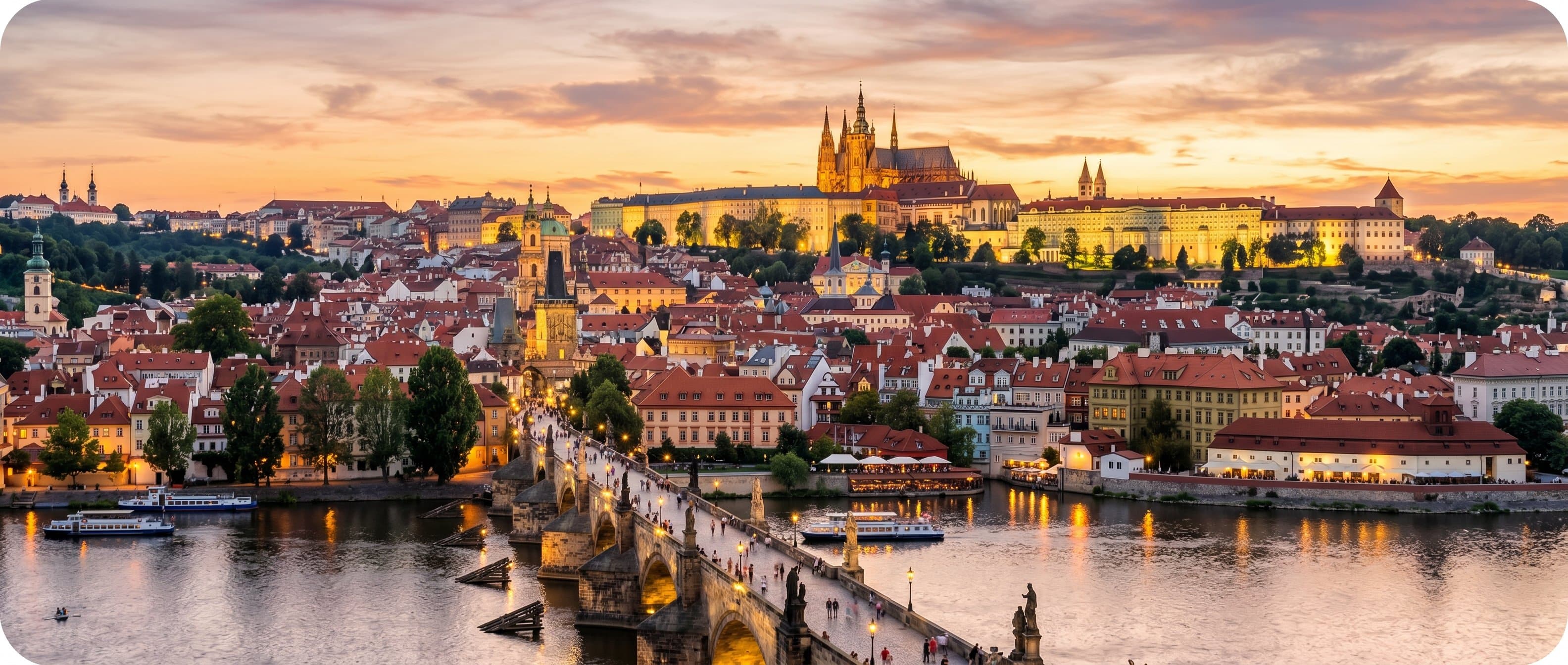
Prague is the capital of the Czech Republic and one of the few major European capitals that survived the 20th century with its historic core almost fully intact. That means Gothic, Baroque and Art Nouveau buildings sit side by side across a compact, walkable Old Town, with Prague Castle overlooking the Vltava River from above. Most travelers need 3 to 4 days to cover the main sights properly, the currency is the Czech koruna (CZK) rather than the euro, and the city is well connected by direct flights and by train from Berlin, Vienna, Munich and Dresden.
This guide covers what to do, how many days to plan, when to visit, how to get around, what a trip actually costs, and the mistakes that catch out most first-time visitors.
Why Visit Prague
Prague earned the nickname "the City of a Hundred Spires" because so much of its skyline survived intact — it was largely spared major bombing in the Second World War, unlike Dresden or Warsaw. That preservation is the main reason people visit: you can walk from a 9th-century castle complex, across a 14th-century bridge, into a medieval town square, without the modern reconstruction you'll find in many other European capitals.
It's also one of the more affordable major cities in Western and Central Europe, since it sits outside the eurozone. A meal, a beer, or a hotel room in Prague typically costs less than the equivalent in Vienna, Munich or Paris, which is part of why it remains a popular stop on multi-city Central European itineraries alongside destinations like Berlin and Munich.
Best Time to Visit Prague
Prague has a continental climate with warm summers and cold, sometimes icy winters. The "best" time depends on what you want from the trip:
| Season | Weather | What to expect |
|---|---|---|
| Spring (April–May) | Mild, occasional rain | Fewer crowds than summer, blossoming parks, comfortable walking weather |
| Summer (June–August) | Warm, 20–28°C | Peak season, longest daylight hours, busiest sights and highest hotel prices |
| Autumn (September–October) | Mild, cooling | Good balance of weather and crowds, harvest and beer festivals |
| Winter (November–February) | Cold, often below freezing | Christmas markets in December, lowest hotel prices, shorter days |
Shoulder season — May, June, September and early October — is generally the best trade-off between good weather and manageable crowds. Check a weather forecast tool closer to your travel dates, since conditions can shift week to week.
How Many Days Do You Need in Prague
| Trip length | Good for |
|---|---|
| 2 days | A weekend hitting the Castle, Old Town and Charles Bridge, with limited time for anything else |
| 3–4 days | The sweet spot for most travelers: main sights plus one museum or neighborhood at a relaxed pace |
| 5–7 days | Time for a day trip (Kutná Hora, Karlovy Vary or Český Krumlov) plus deeper exploration of Vinohrady, Žižkov or Holešovice |
How to Get to Prague
Václav Havel Airport Prague (PRG) is the main international gateway, located about 17 km west of the city center. From the airport, options include:
- Public bus + metro: the cheapest option, using regular city transport tickets
- Airport Express bus: a direct service to the main train station
- Taxi or rideshare: faster but more expensive; use an official taxi rank or a rideshare app rather than unmarked cars offering rides in the terminal
Prague is also a common stop on European rail itineraries. Direct trains connect it to Berlin (around 4 hours), Dresden (around 2 hours), and Vienna and Munich. Because of this, many travelers combine Prague with a wider Central European route rather than visiting it in isolation.
Getting Around Prague
The historic center — Old Town, Malá Strana and the area around the Castle — is compact enough to explore mostly on foot, and cobblestone streets mean comfortable shoes matter more than transport choices there. For getting between neighborhoods, Prague has an integrated public transport network of metro, tram and bus, all covered by the same ticket. Trams are particularly useful for reaching Vyšehrad, Žižkov or Vinohrady without a long walk.
A single ticket typically covers a set time window (rather than a single ride) and works across metro, tram and bus, so it's worth validating your ticket at the start of a journey and keeping it until you're done — random inspections do happen, and fines apply for unvalidated tickets.
Best Things to Do in Prague
Prague Castle and St. Vitus Cathedral
Prague Castle is one of the largest ancient castle complexes in the world and has been the seat of Bohemian kings, Holy Roman emperors and Czech presidents. Inside the walls, St. Vitus Cathedral dominates the skyline with its Gothic spires; the complex also includes the Old Royal Palace and Golden Lane, a row of small historic houses once home to castle workers and goldsmiths.
Charles Bridge
Built in the 14th century, Charles Bridge crosses the Vltava River and is lined with Baroque statues. It's busiest around midday, so early morning or after sunset are better times to cross without fighting through tour groups.
Old Town Square and the Astronomical Clock
The medieval square is anchored by the Astronomical Clock, which performs an hourly show on the hour with moving figures. The clock draws a crowd every hour, so if you'd rather see the square without a crush of people, visit outside the top of the hour.
Jewish Quarter (Josefov)
One of the best-preserved Jewish heritage sites in Europe, with several historic synagogues and the Old Jewish Cemetery, where graves are stacked in layers due to centuries of limited burial space.
Vyšehrad
A fortress complex south of the center with far fewer crowds than the main Castle, plus views over the river and the city that many visitors find just as rewarding.
Petřín Hill
A green hill on the Malá Strana side of the river with walking paths, a smaller lookout tower modeled on the Eiffel Tower, and a mirror maze — a good half-day escape from the busier tourist streets.
Czech Beer Culture
The Czech Republic has one of the highest rates of beer consumption per capita in the world, and Prague's traditional beer halls are as much a part of the city's identity as its architecture. Pilsner-style lager originated in nearby Plzeň, and many pubs still serve it unpasteurized and freshly tapped.
Where to Stay in Prague
| Area | Best for |
|---|---|
| Old Town (Staré Město) | First-time visitors who want to walk to everything; busier and pricier |
| Malá Strana | Quieter, closer to the Castle, still very central |
| Vinohrady | Residential feel, good restaurants, a short tram ride from the center |
| Žižkov | Budget-friendly, known for nightlife, slightly grittier |
If you want help comparing specific properties against your dates and budget, an AI hotel finder can narrow down options by neighborhood.
What to Eat in Prague
- Svíčková — marinated beef in a creamy vegetable sauce, served with bread dumplings
- Guláš (goulash) — a Czech take on the classic Central European stew, usually served with dumplings
- Smažený sýr — fried cheese, a common pub dish
- Czech beer — widely considered part of the essential Prague experience, and often cheaper than bottled water in some restaurants
One honest note for first-time visitors: trdelník, the sweet rolled pastry sold from stalls all over the tourist center, is marketed as a traditional Czech treat but isn't originally from Prague and isn't something most locals eat regularly. It's fine as a snack, just don't mistake it for a Czech culinary institution.
Day Trips from Prague
If you have five or more days, Prague makes a good base for day trips:
- Kutná Hora — a UNESCO-listed historic mining town, home to the Sedlec Ossuary, a chapel decorated with human bones
- Karlovy Vary — a spa town known for thermal springs and colonnaded architecture
- Český Krumlov — a small medieval town with a castle overlooking a bend in the Vltava River, often cited as one of the most picturesque towns in Central Europe
Travelers continuing on to Germany often extend the trip with a stop in Dresden, roughly two hours away by direct train.
Entry Requirements and Visa Information
The Czech Republic is part of the Schengen Area and the European Union. Visitors from many countries, including the US, UK, Canada and Australia, can currently enter for short tourist stays without a visa, subject to standard passport validity rules.
The EU's planned ETIAS travel authorization for visa-exempt visitors has been repeatedly delayed and, as of when this guide was written, still had no confirmed launch date, with some reporting pointing to a possible 2027 start. Because this keeps shifting, don't plan your trip around a specific ETIAS date — check official EU and government travel advisories close to your departure date, and see our visa information page for a broader overview of entry requirements by nationality.
How Much Does a Trip to Prague Cost
Prague remains one of the more affordable Western/Central European capitals, though prices in the historic center have risen in recent years. Rough daily budgets, excluding flights:
| Style | Approximate daily spend | Includes |
|---|---|---|
| Backpacker | Lower end | Hostel dorm, public transport, street food and pub meals, free/low-cost sights |
| Mid-range | Moderate | 3-star hotel, mix of sit-down meals, paid attractions, occasional taxi |
| Comfortable/luxury | Higher | 4–5 star hotel, fine dining, private tours or transfers |
Because exchange rates and prices shift, use a currency converter to check the koruna against your home currency, and a budget calculator to build out a realistic total for your specific trip length and travel style.
Suggested 3-Day Prague Itinerary
Day 1: Old Town and the Castle
Morning in Old Town Square, watching the Astronomical Clock and exploring the surrounding streets. Cross Charles Bridge in the early afternoon before the crowds peak, then spend the rest of the day at Prague Castle and St. Vitus Cathedral.
Day 2: Malá Strana, Petřín and the Jewish Quarter
Explore Malá Strana's quieter streets, then walk or take the funicular up Petřín Hill for views over the city. In the afternoon, visit the Jewish Quarter's synagogues and the Old Jewish Cemetery.
Day 3: Vyšehrad and Local Neighborhoods
Spend the morning at Vyšehrad away from the main tourist crowds, then use the afternoon to explore Vinohrady or Žižkov — good areas for a slower pace, local cafés and a more residential feel before you leave.
Use an itinerary planner if you want to adjust this by pace, interests or the number of days you have.
Mistakes First-Time Visitors Make in Prague
- Only bringing euros: the Czech Republic uses the koruna (CZK), not the euro. Some tourist-area businesses accept euros at poor exchange rates — pay in koruna where possible.
- Using street currency exchange booths: rates at central exchange kiosks are often poor. Withdraw koruna from a bank ATM or use a card with low foreign transaction fees instead.
- Not validating public transport tickets: tickets need to be validated when you start your journey; inspectors do check, and fines apply.
- Visiting the Astronomical Clock only on the hour: the show is brief and the crowd is dense; the clock itself is worth admiring outside that window too.
- Skipping reservations for popular sights: Prague Castle interiors and some museums can have long lines in peak season; booking ahead saves time.
Who Prague Suits
Couples tend to enjoy Prague's romantic streets, river views and evening atmosphere. Solo travelers will find it easy to navigate, with a strong hostel scene and walkable center. Families can manage it too, though cobblestones are hard on strollers and some of the best viewpoints involve stairs or hills — Petřín and Vyšehrad are more manageable than the steep approach to the Castle from Malá Strana.
Frequently Asked Questions
What currency does Prague use?
The Czech koruna (CZK). The Czech Republic is an EU member but has not adopted the euro.
Is Prague expensive?
It's generally more affordable than Vienna, Munich or Paris, though prices in the most touristed streets of Old Town run higher than in local neighborhoods.
Do I need a visa to visit Prague?
Visitors from many countries can currently enter for short stays without a visa. Requirements vary by nationality, and the EU's ETIAS authorization system has been delayed multiple times with no confirmed start date at the time of writing — check current requirements before you travel.
Is Prague walkable?
The historic core is very walkable, though cobblestones and some steep approaches (especially near the Castle) are worth planning around if you have mobility concerns.
How many days should I spend in Prague?
3 to 4 days covers the main sights at a comfortable pace; add extra days if you want a day trip to somewhere like Kutná Hora or Český Krumlov.
What's the best way to get from the airport to the city center?
Public bus connecting to the metro is the cheapest option; a direct airport bus to the main train station or a taxi/rideshare are faster but pricier alternatives.
Is tap water safe to drink in Prague?
Yes, tap water in Prague is treated and safe to drink.